
San Augustine County Court Records After Arrest
After a San Augustine County arrest, the custody file and the court file serve different jobs. The jail record is created around the booking. It may include the arresting agency, intake charge, warrant, bond or hold status, and release entry. The court record is the prosecution file. It can include the complaint, information, indictment, docket sheet, motions, bond orders, plea, trial setting, sentence, dismissal, or acquittal. A booking charge is not always the same charge that appears in court because the prosecutor may reject, amend, reduce, enhance, or present charges to a grand jury.
The local prosecution path runs through the San Augustine County District Attorney, where Paul Robbins is listed as District Attorney. Filed district-court criminal records are kept by the District Clerk, and county-level records may route through the County Clerk. The custody side is separate. Current booking and custody questions belong with jail inmate records, while booking-photo questions belong with jail mugshots.
Find San Augustine County Court Records
Start with the facts that came from the booking: full name, date of arrest, arresting agency, and listed charge. Then check whether a court case has been filed. The official statewide court search path is re:SearchTX, but full access can depend on the court, the type of record, and account permissions. If the portal does not show a San Augustine County case, the next step is not to assume no charge exists. Contact the clerk who handles that court level and ask for the docket sheet, charging instrument, court date, and current disposition.
The screenshot below comes from the official re:SearchTX court-record search portal used for statewide Texas case access.
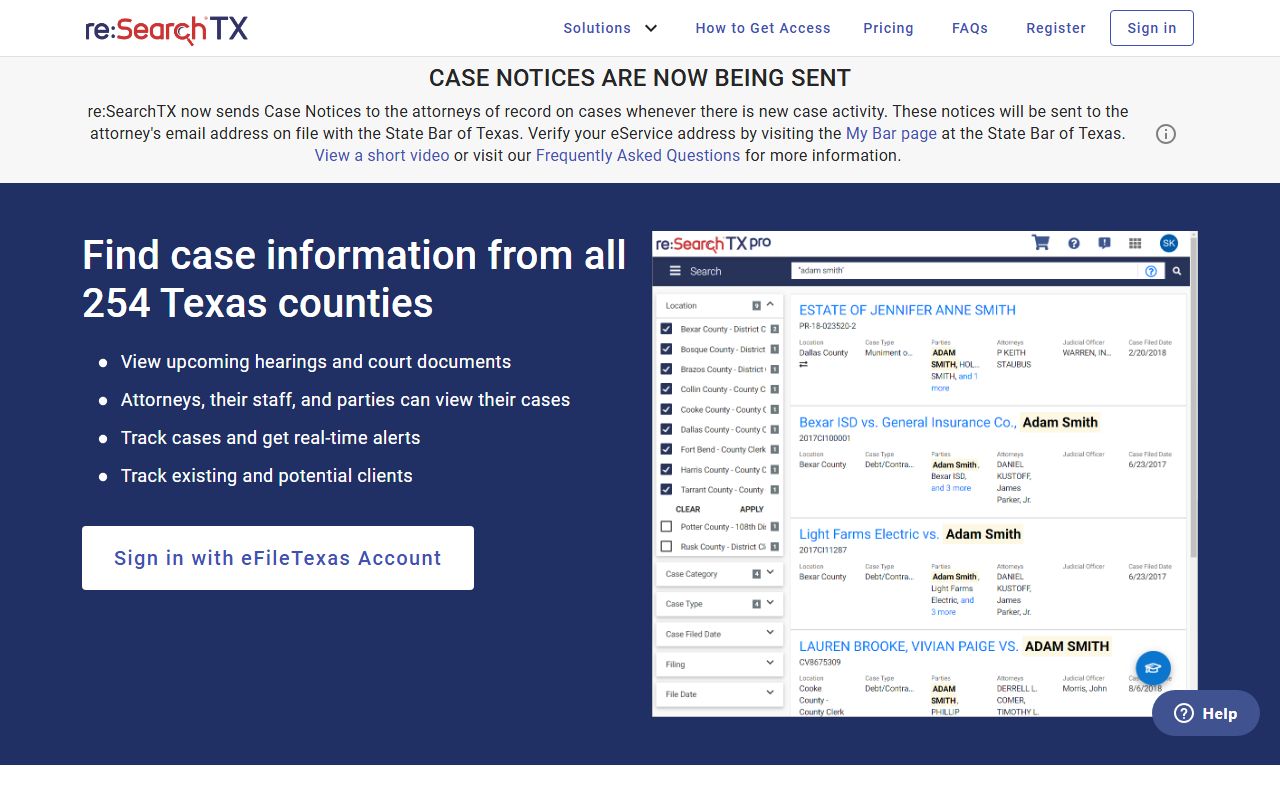
For San Augustine County court records after an arrest, use the portal as an index first, then confirm missing or restricted entries with the local clerk.
| Search Field | Type | Required | How It Helps |
|---|---|---|---|
| Search terms / party name | Text | Optional by search | Searches defendant, party, or case text when a case number is not known. |
| Case number | Text | Optional | Best for direct lookup after the clerk or jail gives a case number. |
| Location / court | Filter | Optional | Narrows results to San Augustine County or a specific court when available. |
| Date range | Date filter | Optional | Helps separate people with similar names and older filings. |
| Login / account | Account | May be required | Some documents or deeper access may not be public without permissions. |
San Augustine County Charge Filing Records
The arrest to court-record path is not instant. A person may be booked into the San Augustine County Jail / El Camino Justice Center on an officer's charge or warrant, then taken before a magistrate without needless delay under Texas Code of Criminal Procedure Article 15.17. That early hearing deals with warnings, rights, and bail issues. The criminal case file grows when the charging document is filed with the court. A misdemeanor, felony, citation, bench-warrant case, or parole hold can each move through a different route.
The San Augustine County District Clerk page says the clerk is the registrar, recorder, and custodian of pleadings, instruments, and papers in District Court. It lists the 1st Judicial District Court and the 273rd Judicial District Court, plus Attorney General Court and CPS Cluster Court. The County Clerk handles county-level records and provides an access link for County Clerk documents. The Justice of the Peace at 221 N Harrison handles JP-level matters such as citations and Class C issues, with after-hours contact routed through the sheriff number.
| Document | Filed By | Common Use | What to Request |
|---|---|---|---|
| Complaint | Officer, complainant, or prosecutor path | Sworn allegation or starting paper in some criminal matters. | Ask for the complaint and docket sheet by defendant name and filing date. |
| Information | Prosecutor | Formal prosecutor-filed charging document, often used outside indictment practice. | Ask whether the information replaced or changed the booking charge. |
| Indictment | Grand jury | Felony charging document returned after grand-jury review. | Ask for indictment count, offense level, case number, and arraignment date. |
San Augustine County Charge Status Records
A charge status tells where the court record sits. It does not prove the final outcome by itself. The court file should be read charge by charge because one count may be dismissed while another remains pending, is amended, or ends in a plea. San Augustine County court records after a jail arrest may also show bond orders, warrants, settings, continuances, or motions that explain why a case is still open. If the online search is unclear, ask the District Clerk or County Clerk for the current docket sheet and disposition for each count.
| Status | Plain Meaning | Why It Matters |
|---|---|---|
| Pending | The charge is filed and unresolved. | The case may still have court dates, bond terms, plea talks, or trial settings. |
| Amended / reduced | The filed charge changed from an earlier version. | The court charge may differ from the jail booking charge. |
| Dismissed | The court ended that charge without conviction. | Check whether other counts remain and whether expunction may be possible. |
| Convicted | A guilty plea, no-contest plea with finding, or verdict resolved the charge. | The case may show sentence, probation, fine, jail credit, or TDCJ transfer. |
| Warrant / capias | The court issued process to bring the person before the court. | A warrant can cause a new San Augustine County jail arrest. |
Note: When a court status is unclear, use the clerk's docket entry rather than a booking label as the final source.
San Augustine County Bond Records
Bond is part of the court and jail pathway, but it is not the same as the final case result. Texas bond law is in Code of Criminal Procedure Chapter 17. San Augustine County does not publish a jail bond page or online bond fee sheet in the sheriff material, so local posting instructions should be confirmed with the jail at 936-275-2424. A caller should ask whether bond has been set, what type of bond is allowed, whether any holds block release, and where payment or surety paperwork is accepted.
| Bond Type | How It Works | Local Checkpoint |
|---|---|---|
| Cash bond | Money is posted directly to secure appearance. | Ask the jail or court what payment forms and hours apply. |
| Surety bond | A licensed bondsman posts the bond for the defendant. | Confirm the bond is accepted in San Augustine County. |
| Personal bond / PR bond | Release is based on a promise to appear and court conditions. | Ask whether the magistrate or court has signed the release order. |
| No-bond hold | Ordinary release is not available or is blocked by another hold. | Check for parole, federal, ICE, bench-warrant, or other county holds. |
San Augustine County Warrant Records
No official San Augustine County online active-warrant search or most-wanted database was found in the county material. That makes direct verification important. Call the sheriff or jail at 936-275-2424 for custody and arrest-warrant questions. City police questions can start with the City of San Augustine Police Department at 936-275-2384. JP-level citation or Class C matters may route to the Justice of the Peace at 936-275-3552, while district-court and county-level warrants may be tied to clerk case files.
Common warrant terms include arrest warrant, bench warrant, capias, fugitive warrant, out-of-county warrant, and blue warrant. A blue warrant is tied to parole. A bench warrant often follows a missed court date or failure to comply with an order. When checking San Augustine County court records after an arrest on a warrant, request the issuing court, warrant number, case number, charge, bond amount if any, and whether the warrant has been served, recalled, or cleared.
Charges vs Court Convictions
A San Augustine County arrest charge is an accusation or custody entry. A conviction is a final court result after a plea, verdict, or other finding allowed by law. Treating the two as the same can lead to wrong conclusions, especially when the prosecutor later files a different charge or dismisses a count. Public court records can show both pending charges and convictions, so the disposition column and judgment entry matter more than the first charge label.
| Point | Charge | Conviction |
|---|---|---|
| Stage | Accusation, filed count, or booking allegation. | Resolved result after plea, verdict, or finding. |
| Proof | May start with probable cause or prosecutor review. | Requires the legal standard for conviction in court. |
| Record clue | Look for complaint, information, indictment, or docket entry. | Look for judgment, sentence, probation order, or final disposition. |
| Risk of confusion | Can be amended, reduced, enhanced, or dismissed. | Should be tied to a final court entry, not a jail label. |
San Augustine County Sealed Records
Texas expunction rules are found in Code of Criminal Procedure Chapter 55. Expunction is a court process for clearing eligible records, often after certain dismissals, acquittals, or other qualifying outcomes. Sealing is different. A sealed record may be hidden from ordinary public view while still available to some agencies or under certain legal conditions. San Augustine County offices should not be asked to remove a court case or arrest record based only on a phone call. A signed court order is the practical record-clearing document.
| Point | Sealed | Expunged |
|---|---|---|
| Public view | Restricted from ordinary public access. | Cleared under the expunction order's terms. |
| Agency access | Some government access may remain. | Access is much more limited after compliance with the order. |
| Best proof | Court order sealing or restricting the record. | Signed expunction order under Texas law. |
| Local action | Provide the order to the record holder if needed. | Provide the order to agencies and offices named in it. |
Note: A dismissal does not erase a San Augustine County arrest record by itself; a court order controls sealing or expunction.
Public Access Limits
Texas public access law matters because criminal records often sit in more than one office. Texas Government Code §552.021 says public information is available during normal business hours unless an exception applies. Government Code §552.108(c) preserves access to basic information about an arrested person, an arrest, or a crime even when some law-enforcement material may be withheld. Court files may still restrict juvenile records, sealed cases, confidential identifiers, medical facts, victim information, or material covered by a court order.
Important: Do not use casual court, jail, or arrest searches for employment, tenant, credit, insurance, or other FCRA-covered screening.
San Augustine County Court Contacts
Use the court office that matches the case. The District Attorney is the charging and prosecution contact, not the clerk for copies. The District Clerk is the district-court record custodian. The County Clerk handles county-level records. The Justice of the Peace covers JP-level matters such as citations and some fine-only cases. When asking for San Augustine County court records after a jail arrest, give the name, date of arrest, case number if known, charge, and the document needed.
Local record path: District Attorney, 100 W Columbia Room 302, 936-275-9903; District Clerk, 100 W Columbia Room 202, 936-275-2231; County Clerk, 106 S Broadway, 936-275-2452.